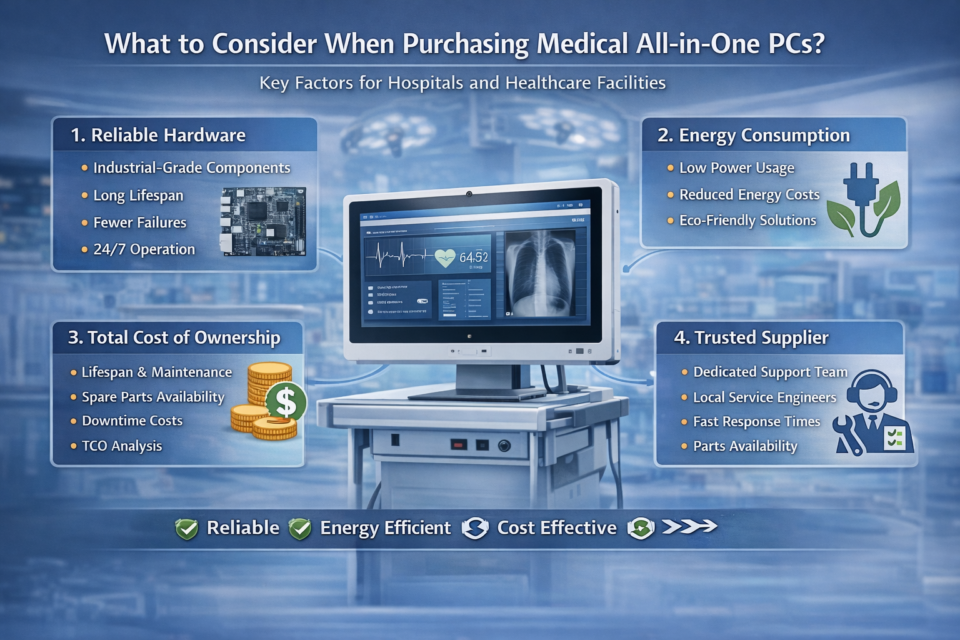

Medical All-in-One PCs are used continuously in healthcare environments. Because these systems are often part of critical care processes, it is important to look beyond just the price or basic specifications when selecting a solution.
Making the right choice has a direct impact on reliability, continuity of care, and the total cost over the lifetime of the system. Below we share three key considerations.
1) Reliability starts with the hardware
One of the most important differences between medical computers lies in the quality of the components used. Some systems are based on standard consumer hardware, while others are specifically designed with industrial-grade components.
Medical systems that use industrial motherboards and components are generally better suited for intensive use in healthcare environments. This type of hardware is designed for long-term availability and stable performance during continuous operation.
For IT departments, this typically means:
- fewer hardware failures
- a longer product lifecycle
- better and longer availability of replacement parts
- more stable performance in 24/7 environments
In a hospital environment where systems are used intensively every day, this can make a significant difference in overall reliability.
2) Energy consumption
At the level of a single PC, energy consumption may seem relatively small. However, in a hospital environment the difference can quickly add up.
For example, if a healthcare organization operates 500 workstations, a difference of just 10 watts per system can result in a significantly higher annual energy consumption.
Lower energy consumption also means that batteries need to be charged less frequently, which increases the effective runtime during a shift and reduces downtime caused by charging cycles. In practice, this leads to better net usability of the workstation and lower operational costs.
For organizations that work with sustainability targets or energy reduction programs, this becomes an important factor to consider.
3) The role of the supplier
In addition to the technical specifications of the product, the supplier is also a critical factor. In healthcare environments, fast support in case of failures is essential.
It is therefore important to look at the organization behind the product. Key questions to consider include:
- Does the supplier have its own service organization?
- Are local service engineers available?
- What are the response times in case of failures?
- How quickly are spare parts available?
A reliable supplier with a well-organized service department can significantly reduce downtime and ensure that systems remain operational for many years.
Conclusion – Total Cost of Ownership
The purchase price of a medical PC tells only part of the story. In practice, the overall cost structure is largely determined by the Total Cost of Ownership (TCO).
When comparing systems, it is therefore important to also consider factors such as:
- system lifespan
- energy consumption
- maintenance and service
- availability of spare parts
- downtime in case of failures
A system that is slightly more expensive initially but operates reliably for five to seven years can ultimately be far more cost effective than a cheaper system that requires frequent replacement or maintenance.
By carefully considering these aspects during the selection process, IT departments and procurement teams can choose a solution that is not only technically suitable, but also sustainable and cost-efficient over its lifetime.