
When selecting a medical AIO workstation, the question is not simply whether batteries are used. In many healthcare environments, batteries are already part of the setup. The real decision is:
Should the computer have its own battery system, or should it use the battery built into the trolley?
This is the difference between a powered PC and a non-powered PC.
Both concepts are widely used in healthcare, and the best choice depends on the customer’s workflow, mobility needs and the equipment connected to the workstation.
What is a powered PC?
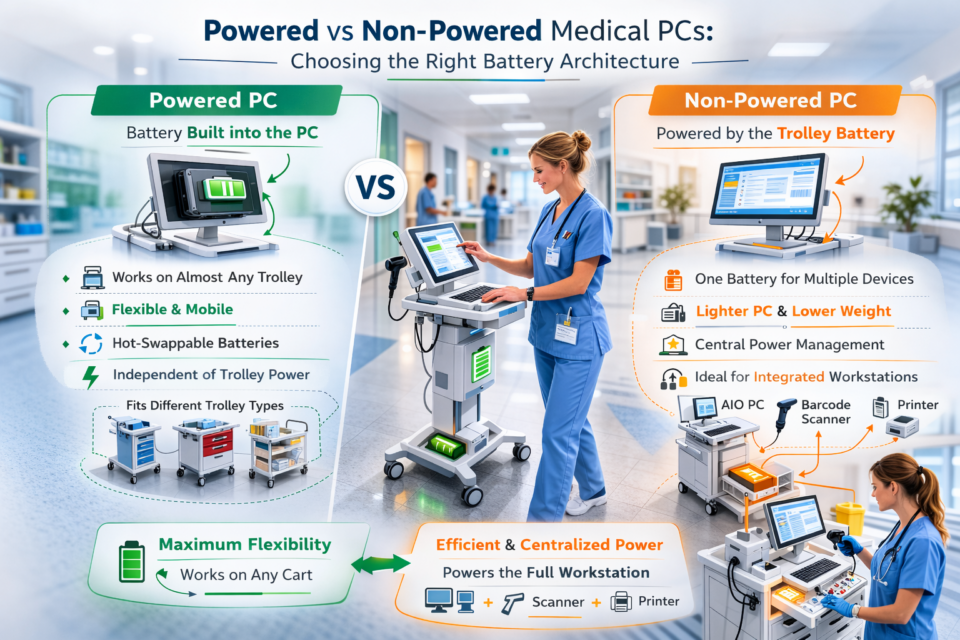
A powered PC has one or more batteries integrated directly into the computer itself. Some designs also offer hot-swappable batteries, allowing batteries to be replaced without shutting down the system.
Because the battery is built into the PC, the computer can operate independently of the trolley it is mounted on.
Advantages of a powered PC
- Can be used on almost any trolley
- Works on carts without onboard battery systems
- Ideal for environments with mixed trolley types
- Easy to move between departments since it’s a stand alone device.
- Can support hot-swappable batteries for continuous operation
Example:
A hospital wants to standardize on one medical AIO PC across several departments. However, some departments use simple trolleys without battery systems. A powered PC allows the same device to be installed on any trolley without redesigning the cart.
What is a non-powered PC?
A non-powered PC does not contain a battery. Instead, it draws power from the battery system integrated into the trolley.
In this architecture, the trolley acts as the central energy source for the entire workstation. Because the battery is not integrated into the PC itself, the AIO is typically lighter and simpler.
Advantages of a non-powered PC
- Lower weight at the PC level
- Simpler hardware design
- Ideal when the trolley already has a battery system
- Allows one battery system to power multiple devices
Example:
A medication cart includes an AIO PC, a barcode scanner and a label printer. In this situation, a trolley with an integrated battery powering a non-powered PC is often the most practical solution, because the same battery system can support the entire workstation.
When a non-powered PC is the better choice and when it isn’t
A non-powered PC is often the preferred solution when the trolley already includes its own battery system or when the workstation does not require independent power at the PC level. In other words, a non-powered PC typically makes sense when the trolley already has onboard battery power, when multiple IT devices such as printers or scanners need to be powered, when lower PC weight is important, or when the workstation is used in a fixed location with access to mains power.
However, a powered PC offers a major advantage when flexibility is important. Because the battery is built into the PC itself, the workstation can be installed on almost any trolley, including carts without an onboard battery system. This makes the solution both flexible and lightweight, as the PC does not depend on a specific powered trolley platform.
Where hot swappable batteries fit in
Hot-swappable batteries are relevant for powered PCs. They allow batteries to be replaced while the system remains operational. This is particularly valuable in environments where carts are used continuously during long shifts.
Conclusion
Choosing between powered and non-powered medical PCs is primarily about where the battery architecture should sit.
A powered PC offers maximum flexibility and works on almost any trolley.
A non-powered PC is lighter and often the better choice when the trolley already provides power, when multiple devices need power, or when the workstation is used in a fixed location.
The best solution depends on how the workstation will be used in real clinical workflows.