
A whitepaper for ICT departments in healthcare
Introduction
Across many industries—including healthcare IT—there is growing confusion around IP ratings. Manufacturers often highlight high IP values to emphasize robustness and durability, while the actual meaning and limitations of these ratings are not always clearly communicated. In some cases, IP codes are replaced by vague marketing terms or selectively presented to suggest a higher level of protection than is formally certified.
For ICT departments in healthcare environments, where hygiene, reliability and safety are critical, misunderstanding IP ratings can lead to incorrect purchasing decisions and operational risks.
This whitepaper explains what IP ratings really mean, how they are officially defined and tested, and where common misconceptions and market misuse occur. To keep the explanation accessible and neutral, a wristwatch is used as an illustrative example rather than focusing directly on IT hardware or specific suppliers.
What is an IP Rating?
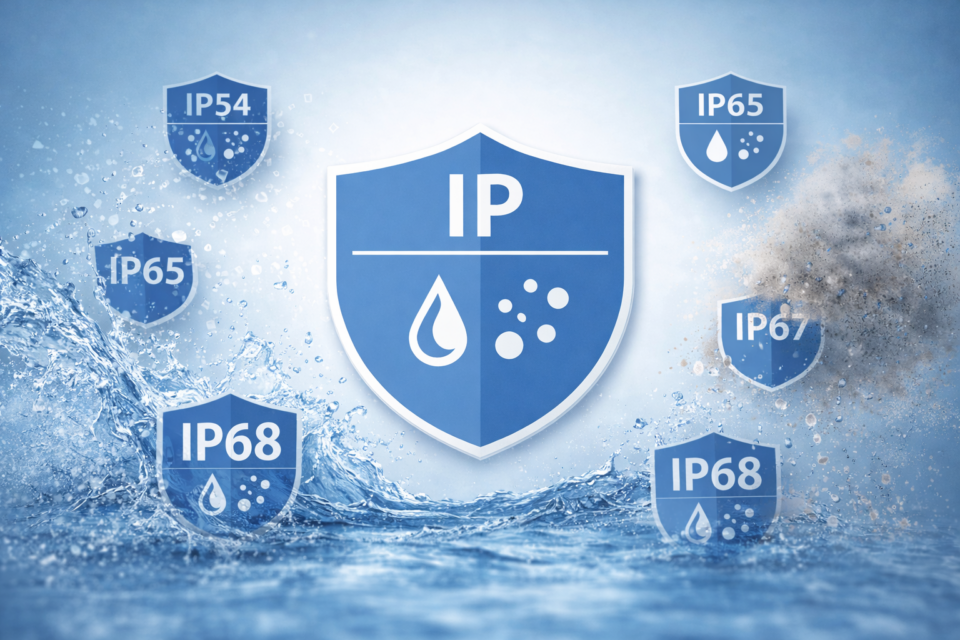
IP stands for Ingress Protection and is defined in the international standard IEC 60529. An IP rating indicates how well an enclosure protects internal components against the ingress of solid objects (including dust) and water.
An IP rating always consists of two digits:
- The first digit indicates protection against solid objects and dust
- The second digit indicates protection against water
The higher the number, the higher the level of protection. An IP rating is only valid if the complete product has been tested according to the standard by an accredited test laboratory. It is therefore a formal certification, not a descriptive marketing term.
Explanation of IP Ratings (IPXY)
First digit – Protection against solids and dust (0–6)
- 0 – No protection
- 1 – Protection against large objects (>50 mm)
- 2 – Protection against fingers or objects >12.5 mm
- 3 – Protection against tools or objects >2.5 mm
- 4 – Protection against small objects >1 mm
- 5 – Dust protected (limited dust ingress permitted, no harmful effect)
- 6 – Dust tight (no dust ingress)
Only a rating of 6 means fully dust-tight. Any lower rating allows some level of dust ingress, even if marketing language suggests otherwise.
Second digit – Protection against water (0–9)
- 0 – No protection
- 1 – Protection against vertically dripping water
- 2 – Protection against dripping water at up to 15°
- 3 – Protection against spraying water
- 4 – Protection against splashing water from all directions
- 5 – Protection against water jets
- 6 – Protection against powerful water jets
- 7 – Protection against temporary immersion (up to 1 m, 30 minutes)
- 8 – Protection against continuous immersion (conditions defined by manufacturer)
- 9 – Protection against high-pressure and high-temperature water jets
If one of the digits is marked as X, that aspect was not tested (e.g. IPX4 means water protection was tested, dust protection was not).
IP Ratings in Practice – The Watch Example
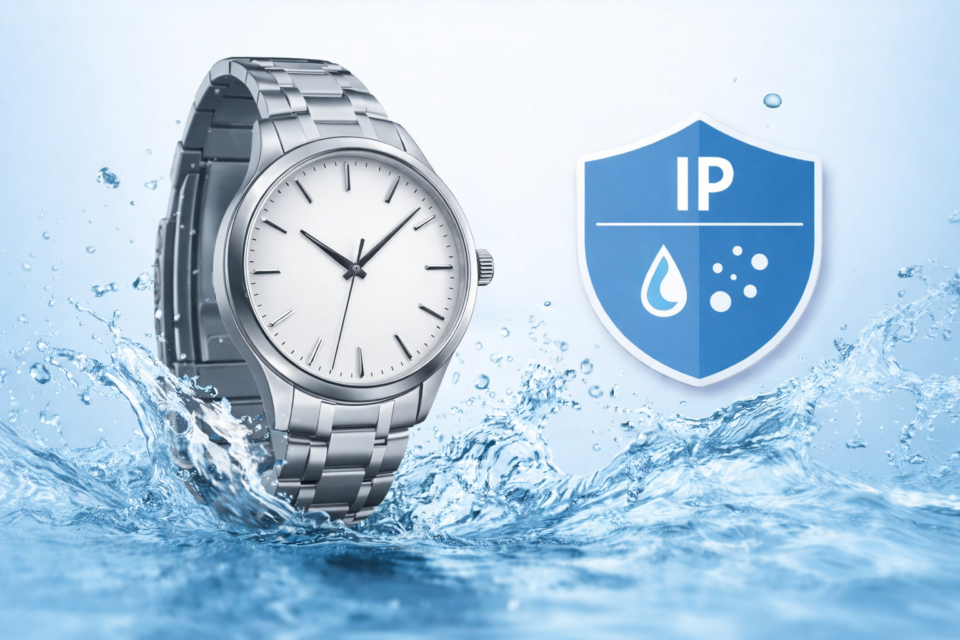
Watches and smartwatches provide a clear and familiar example of how IP ratings are often misunderstood.
A watch with an IP68 rating has been formally tested to be fully dust-tight and resistant to prolonged immersion in water under defined conditions. This allows predictable and verifiable use within those limits.
Now consider a watch described as “equivalent to IP68” or “IP68-like protection”. Without an official IP certification, this statement has no technical or legal meaning. The glass may be well sealed, but if buttons, speakers or sensors on the back are not equally protected, the device as a whole does not meet IP68 requirements.
Importantly, manufacturers that avoid formal certification often also exclude water damage from warranty coverage—shifting the risk entirely to the user.
This principle applies equally to IT equipment: partial protection does not equal full IP compliance.
Common Misuse and Misleading Practices
1. Splitting front and rear IP claims
A recurring practice in the market is advertising different IP levels for the front and back of a device, for example:
“Front side IP65, rear side IP54”
From a certification perspective, this is misleading. An IP rating applies to the entire enclosure, not individual surfaces. The effective protection level of the device is always determined by the weakest point. If water or dust can enter from any side, the overall IP rating is reduced accordingly.
2. Using terms like “comparable to” or “equivalent to”
Phrases such as “comparable to IP65” or “IP65-equivalent protection” are often used when no formal certification exists. These terms have no standing in IEC standards and should be treated as marketing language rather than technical specification.
Without an official test report, there is no objective verification of such claims.
3. Misinterpreting dust protection
A common misconception is that devices with IP4X or IP5X ratings are “dustproof”. In reality:
- IP4X still allows significant dust ingress
- IP5X allows limited dust ingress
- Only IP6X is fully dust-tight
Describing anything below IP6X as “dustproof” is technically incorrect.
4. Overstating “waterproof” capability
The term “waterproof” is frequently used without context. IP tests are performed under controlled conditions (fresh water, defined pressure, limited duration). Real-world factors such as cleaning agents, disinfectants, temperature changes or ageing seals are outside the scope of IP testing unless explicitly specified.
For healthcare environments, this distinction is critical.
Why This Matters in Healthcare IT
In hospitals and clinical environments, devices are exposed to:
- Frequent cleaning and disinfection
- Moisture and splashing
- Dust-controlled or cleanroom-like conditions
Incorrect assumptions about IP protection can result in premature failures, downtime, hygiene risks and unexpected costs. Moreover, warranty claims may be rejected if actual usage exceeds the certified IP limits.
For ICT departments, clarity and accuracy in IP specifications are therefore essential.
Practical Recommendations for ICT Departments
When evaluating equipment, consider the following:
- Ask for the official IP rating of the complete device
- Request test reports or certificates from accredited laboratories
- Be cautious with terms like “equivalent”, “comparable” or split IP claims
- Verify whether cleaning procedures are compatible with the certified IP level
- Check warranty exclusions related to moisture or dust ingress
Transparency is a strong indicator of product quality and supplier reliability.
Conclusion
IP ratings are a valuable and reliable tool—when used correctly. They provide a standardized, verifiable way to assess protection against dust and water. However, selective communication, vague terminology and partial claims undermine their purpose and can lead to costly misunderstandings.
For healthcare ICT environments, where reliability and hygiene are non-negotiable, clear and honest IP specifications are not a luxury but a necessity. Always rely on certified data, not marketing language.